Learn music theory step by step, and finally read any sheet music
Work out a new piece on your own, follow your part in choir without leaning on the singer next to you, and lay the groundwork to improvise one day. We start from zero, ten minutes a day, and it's free.
No sign-up, no account: your progress stays on this device.
Where should I start?
It depends on where you are coming from. Find your situation and we will point you to the right starting place.
You are starting from scratch
Don't worry, everyone has been there. Start with the first lesson: it takes eight minutes and begins with a sound.
Start lesson 1You play an instrument
Pick it next to the “Play the scale” button: every example in the course will play on it. On guitar, bass, violin or cello, you will even see where each note sits on the neck.
Choose my instrumentYou sing in a choir
Start by reading notes in treble clef, then learn to count rhythm. With those two skills, you can follow your part without leaning on the singer next to you.
Read treble clef notesYou learned as a child, then forgot
That is very common, and it comes back faster than you think. Take the practice exam to see what you remember, then pick up where it gets shaky.
Take the practice examYou are preparing for a theory exam
The course follows Danhauser's curriculum, part by part. Every lesson has its questions, and the practice exam lets you review the parts you choose.
See the full courseYou teach music
Assign a lesson as homework, print it with its answer key, or generate worksheets for the whole class.
The page for teachersHow a lesson works
Every lesson takes about ten minutes and always runs the same way. The best way to see it is to try it.
First, you listen
Every idea starts with the sound. Before you learn to write a fifth, you hear one. Press the button: these two notes, C then G, make a fifth. Great music educators, from Kodály to Edwin Gordon, summed it up in one phrase: sound before sign.
Then, you name it
You put a name on what you just heard, and you practice right away. The exercises correct you instantly. Try this one: which note is this?
What is this note?
The next day, you recall it
The next day, the question comes back in your daily review. Then three days later, a week, three weeks. Finding the answer yourself instead of rereading, and spacing out your reviews: these are the two methods learning research rates as the most effective.
Sources: Edwin Gordon's music learning theory (“sound before sight”), and the 2013 review by Dunlosky and colleagues, which compared ten study techniques. Gordon, Dunlosky (2013).
And if you have tried before, without success
Many adults have bad memories of music theory. They were asked to recognize symbols before hearing what those symbols stand for, and to learn rules once, never to revisit them. Without the sound, a rule stays abstract, and what you never revisit fades. Here it is the opposite on both counts. It was never a matter of talent; it was a matter of method.
You already know more music theory than you think.
Every interval has its song. Tap one: you'll hear its two notes, the leap everybody recognizes in that tune. In the course, every topic comes with this kind of anchor: a familiar song, an image or a memory trick.
The whole curriculum
Here is everything we will cover together, in order. Each part opens on its list of lessons.
- PreludeMusical sound, before the signs, 1 lesson
- IThe Signs of NotationStaff, notes, clefs, rests, accidentals, durations, 15 lessons
- IIScales and IntervalsWhole and half steps, enharmonics, intervals, 9 lessons
- IIITonalityScales, key signatures, modes, modulation, transposition, 16 lessons
- IVMeter and RhythmBeats, simple and compound meter, rhythm, tempo, 12 lessons
- VMusical PerformancePhrasing, articulation, dynamics, character, 4 lessons
- AOrnaments and AbbreviationsSupplement A, 3 lessons
- BChordsSupplement B, 3 lessons
- CInstrumentsSupplement C, 2 lessons
- Notes and Modern AppendicesModes, notations around the world, 2 lessons
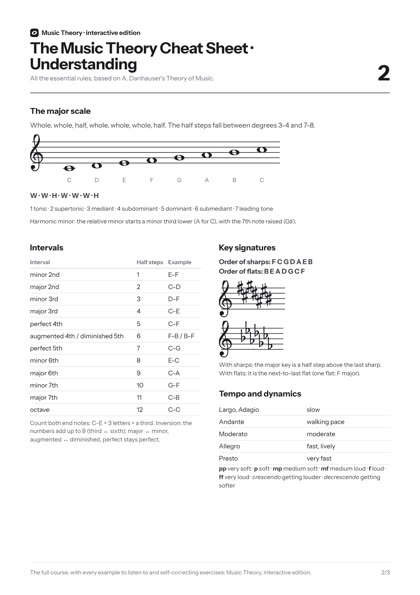
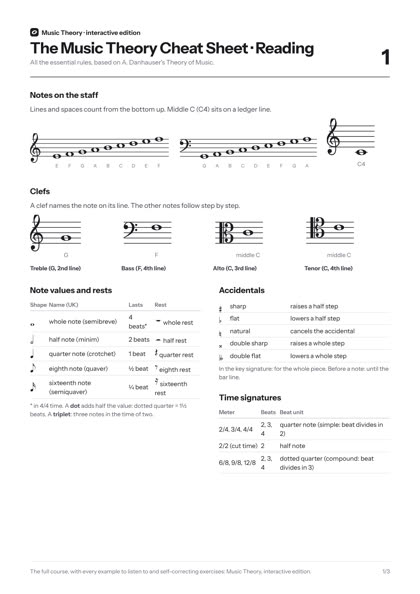
Get the music theory cheat sheet
- Keep every basic rule in front of you: clefs, rhythms, accidentals, time signatures, intervals, key signatures, Italian terms.
- Find a key signature or an interval at a glance while you play.
- Then, if you like, choose the lesson of the day by email for 30 days.
Three printable PDF pages to keep on your music stand, with a 30-day plan, one lesson a day.
To practice
These tools are free to use, even without following the course.
- Online Piano Keyboard with Note NamesPlay the notes and see their names and place on the staff
- Note Identification GameTimed game in 8 clefs
- Printable worksheetsExercises with answer keys and staff paper, generated on demand
- Clef ComparisonOne pitch written in all 7 clefs
- Note Value TreeFrom whole note to 64th note
- Duration CalculatorDots, double dots, triplets
- Voice RangesSoprano, alto, tenor, bass
- Interval CalculatorThe name, quality, make-up and inversion of any interval
- Name the IntervalGenerated drill, three levels
- Interval Ear TrainingRecognize by ear
- Scale BuilderMajor, minors, chromatic, modes
- Interactive Circle of FifthsKey signatures, relatives, related keys
- Key Signature QuizName the key from its signature
- TranspositionNew key, reading clef, accidentals
- MetersSimple and compound, heard and counted
- Online Metronome and Tap TempoSet a tempo, or tap along to find the BPM of a song
- Conducting PatternsPatterns in 2, 3, 4
- ChordsTriads and sevenths on every degree
- Harmonics and TemperamentHarmonic series, the comma
- InstrumentsRanges and transpositions
- Tuning Pitch415, 435, 440, 442, 443 Hz
Your questions
Is it really free? What's the catch?
The course, the exercises and the workshops are free, with no sign-up and no limits. The site will be funded by discreet ads, never in the middle of an explanation or an exercise, and, later, by optional extra content.
Do I need an instrument?
No. A keyboard appears on screen and every example plays right in the page. If you have an instrument, even better: you can try everything on it.
How much time per day?
Ten to fifteen minutes. Consistency matters more than length: one lesson a day beats two hours on Sunday.
I'm an adult. Isn't it too late?
No. The course is written for adults: no nursery rhymes, direct explanations, and you go at your own pace. What takes years is virtuosity on an instrument, not reading.
I already play, by ear or with tabs. Is this for me?
It teaches you to read and understand written music: notes, rhythm, keys, intervals, chords. That's the foundation for everything else. If your goal is mainly to improvise or write songs over chord progressions, this course lays the groundwork, but it doesn't teach those practices.
How is my progress kept without an account?
It's saved in your browser, on this device. On the “Course” page, a resume code lets you restore it on another device or after clearing your browser.
I'm preparing for a theory exam.
The course follows Danhauser, a textbook still used in French conservatories. Every lesson has a quiz, and the practice exam draws questions from the parts you choose.
Does it really work?
The course rests on two established principles: hearing before reading, and regularly retrieving what you learned rather than rereading it. It will not make you a fluent sight-reader in a month; reading fluently takes months of practice. It gives you the order, the exercises and the reviews to get there.
It never stuck. Maybe I'm just not musical.
Reading music is learning a language, not revealing a gift. When rules don't stick, it's often because they were learned without the sound and without practice. Here every topic is heard and practiced until it sticks.
Is there a French version?
Yes, the whole course exists in French: FR button at the top of the page.
Ready? The first lesson takes eight minutes, and it starts with a sound.
Start the first lesson